
More IT security for the university – passkeys are coming to JGU!
Universities have been increasingly targeted by cyber-attacks in recent years. Phishing emails have been the main cause. The consequence: entire institutions have been unable to act for months. The University of Mainz is to be protected against this in the future as well.
To significantly better protect your data and your JGU account, ZDV is gradually introducing passkeys for browser-based applications and services at the university.
Note: You do not need a passkey for Microsoft 365 apps (e.g. OneDrive and Teams) or Adobe products. Enter your username and password as usual on the JGU login page.
What are passkeys?

Unlike passwords, you no longer have to remember a long string of characters.
In future, you can create passkeys on the following devices:
- Work computer in the office
- Work laptop for mobile working
- USB security key
- Business/private smartphone
- Private computer/laptop
Timetable & changes
All news on the topic of passkeys: https://www.en-zdv.uni-mainz.de/tag/passkey/
ZDV is introducing passkeys at the university step by step.
- Since May 2026
- If you have already created one or more passkeys, you must use them to log in to all browser-based applications.
- Exceptions: Microsoft 365 apps and Adobe products. Enter your username and password as usual on the JGU login page.
- Since October 2026
- Lecturers on contract, visiting scholars and student assistants can create and use passkeys.
JGU login page
The URL of the official JGU login page is login.uni-mainz.de
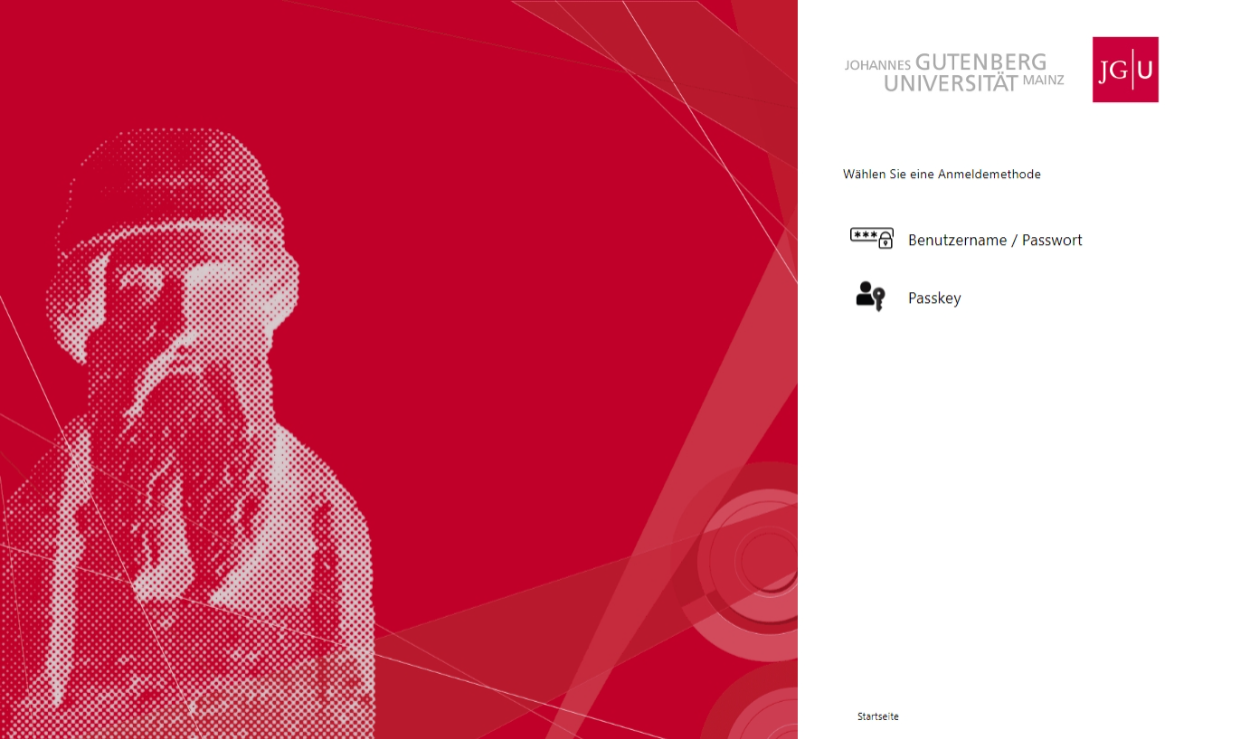
Benutzername / Passwort (username / password)
- Choose this login method for Microsoft 365 apps (e.g. OneDrive and Teams) and Adobe products.
Passkey
- Choose this login method for browser-based applications, for example:
- mail.uni-mainz.de
- arbeitszeit.uni-mainz.de
- personen.uni-mainz.de
- raeume.uni-mainz.de
- maps.uni-mainz.de
Advantages over passwords
Passkeys are more secure than passwords
- Phishing methods that aim to steal login credentials no longer work. Login credentials can no longer be passed on to criminals by mistake.
- It is no longer possible to use the same combinations of numbers and letters for different services/applications.
- Password lists become unnecessary.
- The passkey remains on the device you use for it (e.g. your smartphone). It is not passed on to web services.
- In the event of security breaches or suspected misuse, passkeys can easily be deleted and replaced with new ones.
Passkeys are user-friendly
- Unlike with a password, you do not have to remember the generated character string yourself. This is handled by your smartphone, USB security key, laptop or computer.
- A passkey only has to be created once and can then be used again and again.
More information (instructions and frequently asked questions)
- Create and use passkeys: https://www.en-zdv.uni-mainz.de/create-and-use-passkeys/
- Frequently asked questions: https://www.en-zdv.uni-mainz.de/passkeys-frequently-asked-questions/
- Single Sign-On: https://www.en-zdv.uni-mainz.de/single-sign-on/